Inspired by the subway take⤴ of Mindy Seu on Kareem Rahma's show:
We should gossip more.
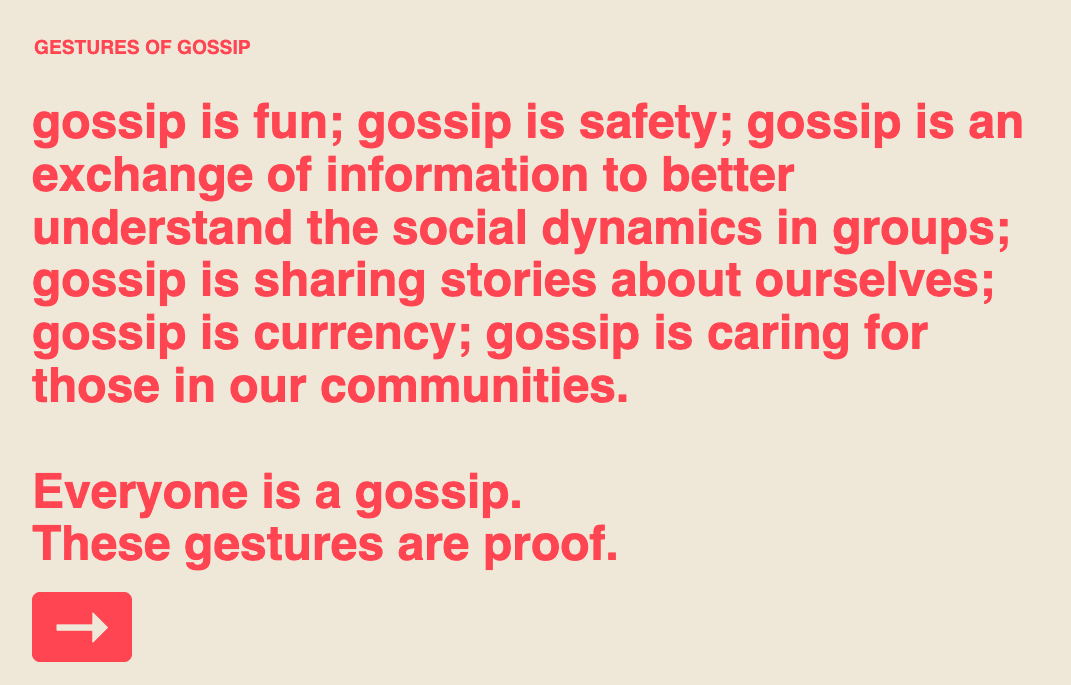
Gossip originated to help bond the groups of people that were constantly growing in size. Conversation and language were able to bridge the gap between physical distance between these groups. It helped the group gain information about other individuals without personally speaking.
Gossiping is usually seen as passive-aggressive and bad. It is often accompanied by uncomplimentary adjectives. This might be caused because in earlier centuries, women were supposed to be quiet, and obey their husband without question. They might even be discouraged to pay too many visits to friends or family. Female friendships were one of the targets of the witch hunts.
But gossip builds trust. It is more useful and serious than you realize.

It might be the case that gossip is negatively framed because it works against oppression by keeping the subjects silent and submissive. It keeps women isolated. In a white, cis-heteronormative, patriarchal society, the intimate conversations that take place in marginalized communities often get labeled as gossip and carry connotations of being vapid, shallow and even harmful.
Gossip has kept women and marginalized communities safer for millennia. It is only considered bad cause it is associated with women. Gossip is “that frat house is dangerous” and “keep driving right through that town, it’s a sundown town.” That keeps us safe. (source⤴)
There has been research done on whisper networks⤴, which are informal communication networks women use to share information. It both builds community and provides safety and stability. Especially when it comes to sexual harassment, for example. Gossip has endured as a mode of knowledge-sharing on the outside of the mainstream.
It might lead to finding out how much your male colleague makes at your workplace, and aiming higher. It might also be about talking it out to understand how you feel about an experience with someone. You might not take your feelings seriously because you wave it off as unimportant, but when multiple of your girlfriends have the same gut feeling - what would that do to you?
What kinds of stories can only be shared in certain spaces - in the midst of preparing food in the kitchen, or in the club bathroom. "We see gossip as a feminized form of sharing, indulging in, and relating to those taboo, non-normative experiences that are expressed in the safety of secrets." ¹
The difference around ethics might come from the types of gossip we're talking about. But I would like to propose that the negative isn't even really that negative? Not outweighing the positive effects it could have, at least. We're still bonding, sharing knowledge, learning each other's values and reactions to things. A great purpose of gossip is helping us understand our own perspective.
To gossip, then, isn’t to malign or spread false rumors; it’s to share information and wisdom, to cultivate fellowship, to acknowledge that we are all equals, that we are all in this—this life, this work, this planet—together. That is, to gossip is an act of solidarity, even, at times, of love. (Mandy Brown⤴)
References
- Are.na board⤴ of Mindy Seu
- This EVEN BETTER Are.na board⤴ by Deborah Khodanovich
- Podcast episode about Gossip⤴ by Helen Zaltzman, Lainey Lui and Anne Helen Peterson
- Substack The Gossip Matrix⤴ by Haley Nahman