The internet felt magical during my earliest days online. It felt like a realm of discovery, creativity, and connection. It was a place to explore your identity, express interests, and connect with other humans around the world.
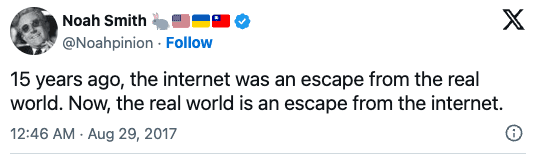
This landscape has been transitioned into big modern stores, compared to the old classical city with meandering paths and pretty sights to see. There's less diversity and more dependence on what these big stores provide us. This is also called the attention economy, where artists and media-makers get paid by the quantity of attention they are getting.
In this note, I want to re-image what a new social media world could look like. The big platforms have comprised so much of our online experience for so lang that it can be hard to envision anything different. But nothing about the internet is fixed, permanent or inevitable. We have to take more responsibility in guarding our own data and taking charge of distributing our words, images and thoughts.
I would love to have more calm technology, or to have more value placed on design justice principles in the way we use tech. Instead of fragmented content, divorced from context, I would like to see more context-rich, associative media. No interruption technology, but ideas that we could explore on our own demand.
The goal is not to have teacher-like measures in place that tell us when to stop scrolling because we have been bad. The goal is also not to "fix Instagram", because the medium really is the message⤴, and the current architecture is just inherently bad.
The goal is to spend our attention and time with care. We should have a digital landscape that makes us happy, interesting, and calm.
Possible routes to take
On intention and thoughtfulness
-
No infinite scroll. If you've seen it all, you've seen it all. There's the cognitive overload theory which talks about the maximum amount of information our working memory can process at any given time - a big reason why we feel "brain rot". You can of course blame people for not closing their apps whenever they feel a bit overwhelmed, but we often do not realize we are feeling that way because of what we are doing at that moment. The blame should be with big tech that have their apps purposefully engineered to keep us scrolling. We should feel no shame that it is very hard to resist this intentionally placed urge. There must be a systemic, intentional move towards limiting the amount of information we can consume.
-
The availability for chronologically sorted timelines. No algorithm deciding what you should see first, or what is more important. This also makes it easier to catch up with stuff you have seen before.
-
Some sort of closing time. Just like TV would get boring after a certain hour of the day, there should be nothing interesting to see there anymore after 10PM (very arbitrary hour, could be earlier or later). It would be even better if the app icon on your homepage would vanish, and only appear again whenever "opening hours" start again.
-
You can only comment after you have watched the full video. It is so tempting, and so human-like, to already check the comments before you have watched the entirety of the video. This way, it is very easy to already form an opinion before watching a video, which makes it all very friction-less. No more of that. You have to watch the full video first, before you can comment on it.
-
You have to say hi to five new people before you can post anything.
-
You can only comment on videos after you have created a few posts yourself. Not 100% yet sure about the feasibility of this point (because you can of course just create fake or meaningless comments), but I am aiming for more vulnerability and less lurking. No anonymous trolls.
-
The ability to choose to have quiet days when we could mute our feeds temporarily. Or mute ourselves from showing up on other people's feeds. Also as "creators", there should be room to breath.
-
The notifications are by default off. No more interruption technology.
-
Built-in reminders to break a break from scrolling and attending healther habits.
On creativity
-
No (fully) AI generated content allowed on social platforms. Not using AI should be a flex. Either AI generated media should be watermarked, or content has to be filmed/edited/posted within the app.
-
An intentional framework on adding more features to the platform could include not overwhelming the users with features. Sometimes users get more creative when they have to use unconventional ways to use the platform. See also the concept of folk programming.
-
Not only a private "saved" folder, but also the ability to have public saved folders so others can see your interests while you can be the curator of your own interests and passions.
-
A re-imagination of how we can add value to work that is difficult and takes a long time. Currently, a 10-second TikTok is shown in the same feed as 2-hour documentaries, battling each other for a finite number of eyeballs and clicks. People are expected to create work better, bigger, faster, and cheaper. This isn't a sustainable way to work, and it diminishes the space required for deep, concentrated thought. The insane pace doesn't benefit the creators, and it doesn't benefit the consumers either. There's too much content for people to consume anyway.
-
Maybe there are no profiles and the feed is a random constellation of images for every minute of the day.
On connection and community
-
Maybe more specific, niche social media apps that are set towards people with a certain interest or hobby, instead of a few big apps that are aiming to reach everyone.
-
More focus on connection and context between ideas.
-
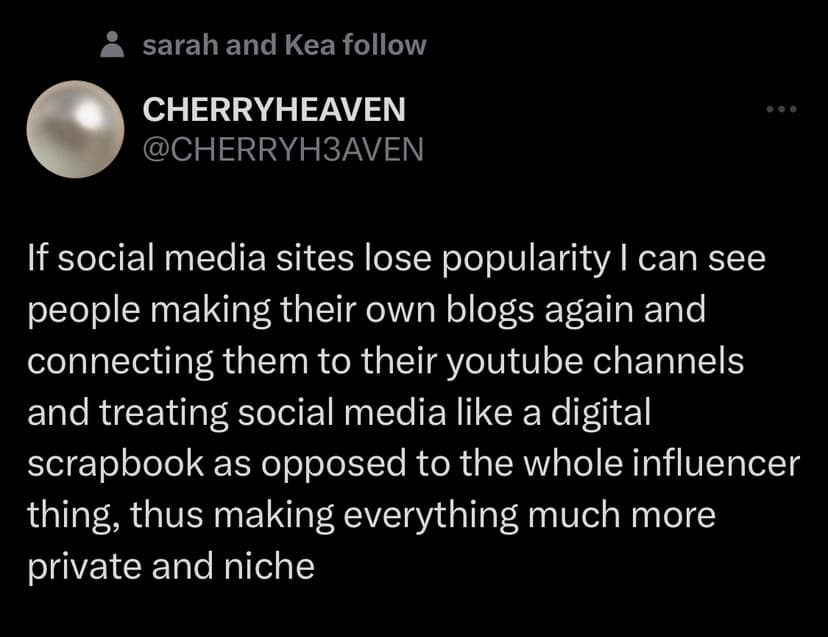
Little digital social networks where it is only focused on you and your close circle. Secret hideout pages which you can decorate and on which you can invite your friends to leave notes or pictures. Spontaneous connection with friends in local chats. Little moments of connection with long-distance family. These could be valuable infrastructures for (digital) care and community.
-
Figuring out new metrics that are shown on the bigger platforms. Instead of trying to reach many people, reaching a small number of people in a more meaningful and memorable way. Thinking about what sustainable growth would look like. This also means that there is more room for artists to make complex work with nuance, which isn't measured in only a few seconds by the algorithm.
-
Similarly, we could promote that it's okay to revisit and garden old ideas. And to explore ideas that live outside the platform. There could be an encouragement ot explore other parts of the internet and then come back to the platform as a home base.
-
Instead of an algorithm suggesting you other accounts, what if users could suggest accounts they want you to follow?
-
The ability to go quietly public⤴ on the internet by not necessarily having to share your name / face / voice / relationships.
On sovereignty and safety and independency
-
It has to be very easy to own your data and take whatever you have posted on a platform to another platform. You have the right to leave.
-
An integrated tool that connects quotes, images, and video clips to their sources. We can do a lot with reverse image search. We should be able to connect people to multiple news stories about the same event, helping us see how different media outlets tell us the news. Bits of information provide neither meaning nor orientation, they are purely addictive. From a certain point onwards, they no longer inform, they deform. We should think about how social issues on social media can be effective instead of overwhelming.
-
There should always be the option be anonymous.
-
Apps should not be able to have your location for very little, irrelevant features. There's so much personal information collected in cases where this isn't necessary.
Reference
- The Battle of Attention⤴ by The New Yorker
- I love what Spencer Chang⤴ is doing with his open-source work at PlayHTML⤴ where you can use the components to create your own communal internet experiences.
- Essay Take Back The Future! The progressive case for techno-optimism⤴ by Jasmine Sun